 Image 1 of 1
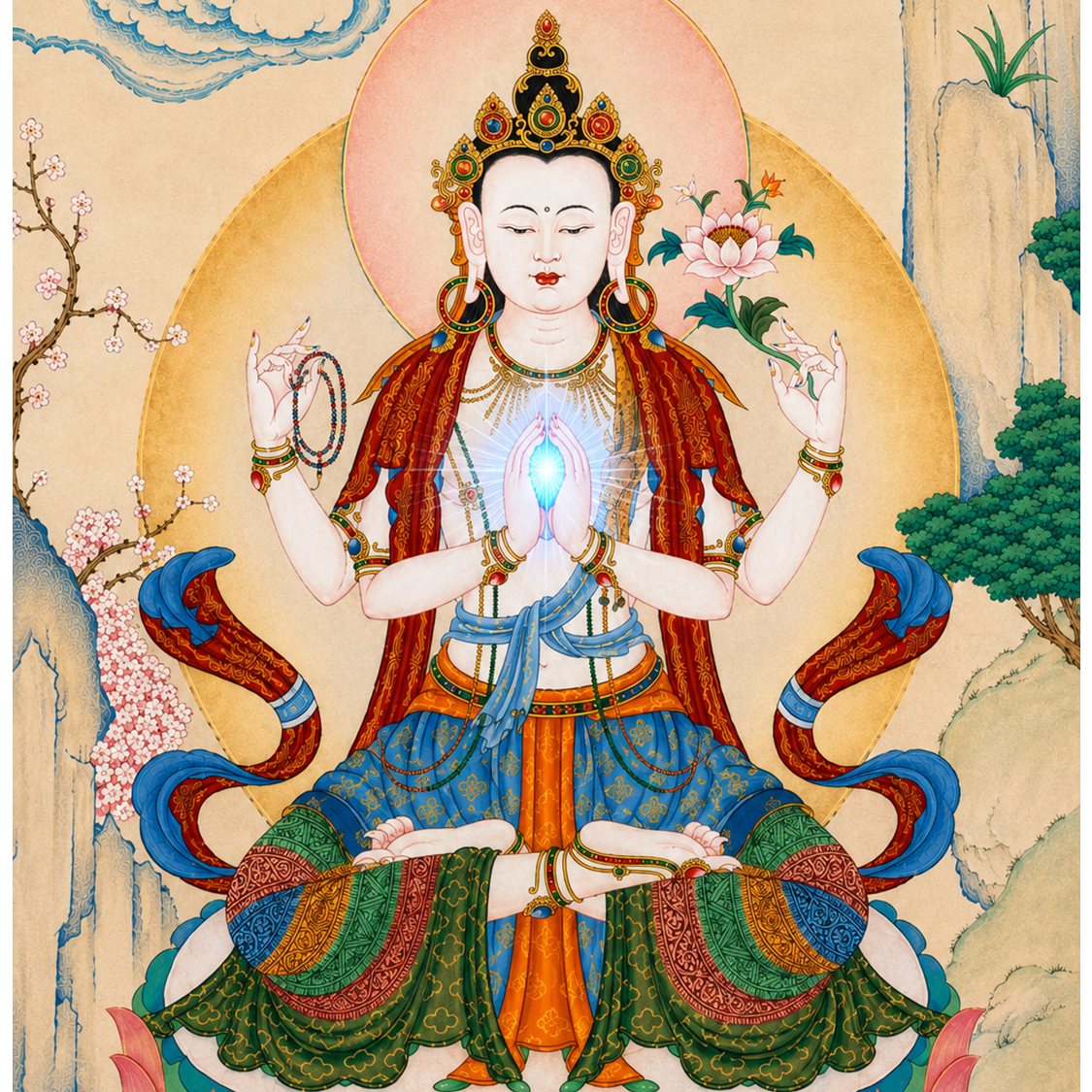
One of the most beloved figures in Tibetan Buddhism, Avalokiteśvara (Tib. Chenrezig) was chosen as the cover of Boundless Caring, Clear Awaring – The Heart of Bodhicitta. The four-armed emanation shown here is known as Ṣaḍakṣarī Lokeśvara, “Lord of the Six Syllables,” because he embodies the mantra Oṃ Maṇi Padme Hūṃ. Seated upon a moon disc in the heart of a lotus, his luminous white body suggests a mind purified of hatred, grasping, and self-concern. His four arms express the Four Immeasurables: loving-kindness, compassion, sympathetic joy, and equanimity. At his heart, his joined hands hold the radiant wish-fulfilling jewel, the treasure of bodhicitta itself: the awakening heart-mind that seeks buddhahood for the benefit of all beings.
In his outer hands, Avalokiteśvara holds a crystal rosary and a white lotus. The rosary signifies his ceaseless compassionate activity, the continuous turning of mantra and blessing for beings caught in suffering. The lotus blooms unstained from muddy waters, showing how compassion enters saṃsāra without being corrupted by it. Though adorned in celestial silks, jewels, crown, and ornaments, his splendor is not worldly luxury but the richness of awakened qualities. The antelope skin over his shoulder symbolizes gentleness, patience, and nonviolence. For this book, Avalokiteśvara is not merely a sacred image on the cover. He is the living icon of its central teaching: boundless caring joined with clear awaring, compassion made vast by wisdom, wisdom made warm by love.
One of the most beloved figures in Tibetan Buddhism, Avalokiteśvara (Tib. Chenrezig) was chosen as the cover of Boundless Caring, Clear Awaring – The Heart of Bodhicitta. The four-armed emanation shown here is known as Ṣaḍakṣarī Lokeśvara, “Lord of the Six Syllables,” because he embodies the mantra Oṃ Maṇi Padme Hūṃ. Seated upon a moon disc in the heart of a lotus, his luminous white body suggests a mind purified of hatred, grasping, and self-concern. His four arms express the Four Immeasurables: loving-kindness, compassion, sympathetic joy, and equanimity. At his heart, his joined hands hold the radiant wish-fulfilling jewel, the treasure of bodhicitta itself: the awakening heart-mind that seeks buddhahood for the benefit of all beings.
In his outer hands, Avalokiteśvara holds a crystal rosary and a white lotus. The rosary signifies his ceaseless compassionate activity, the continuous turning of mantra and blessing for beings caught in suffering. The lotus blooms unstained from muddy waters, showing how compassion enters saṃsāra without being corrupted by it. Though adorned in celestial silks, jewels, crown, and ornaments, his splendor is not worldly luxury but the richness of awakened qualities. The antelope skin over his shoulder symbolizes gentleness, patience, and nonviolence. For this book, Avalokiteśvara is not merely a sacred image on the cover. He is the living icon of its central teaching: boundless caring joined with clear awaring, compassion made vast by wisdom, wisdom made warm by love.